




Fine Pictorial Afghan rug wool and silk pile
Rug Size: 86 x 93cm
Underlay to match the size of this rug
Foxi Rug Underlay 90cm width roll
Size: B - 1 metre
£15.00
This is a an interesting handmade rug and is undoubtedly a talking-point piece which you can lay on your floor or display on a wall; perhaps it is a rug for a collector or rug enthusiast or maybe someone with a deep rooted interest in Afghanistan.
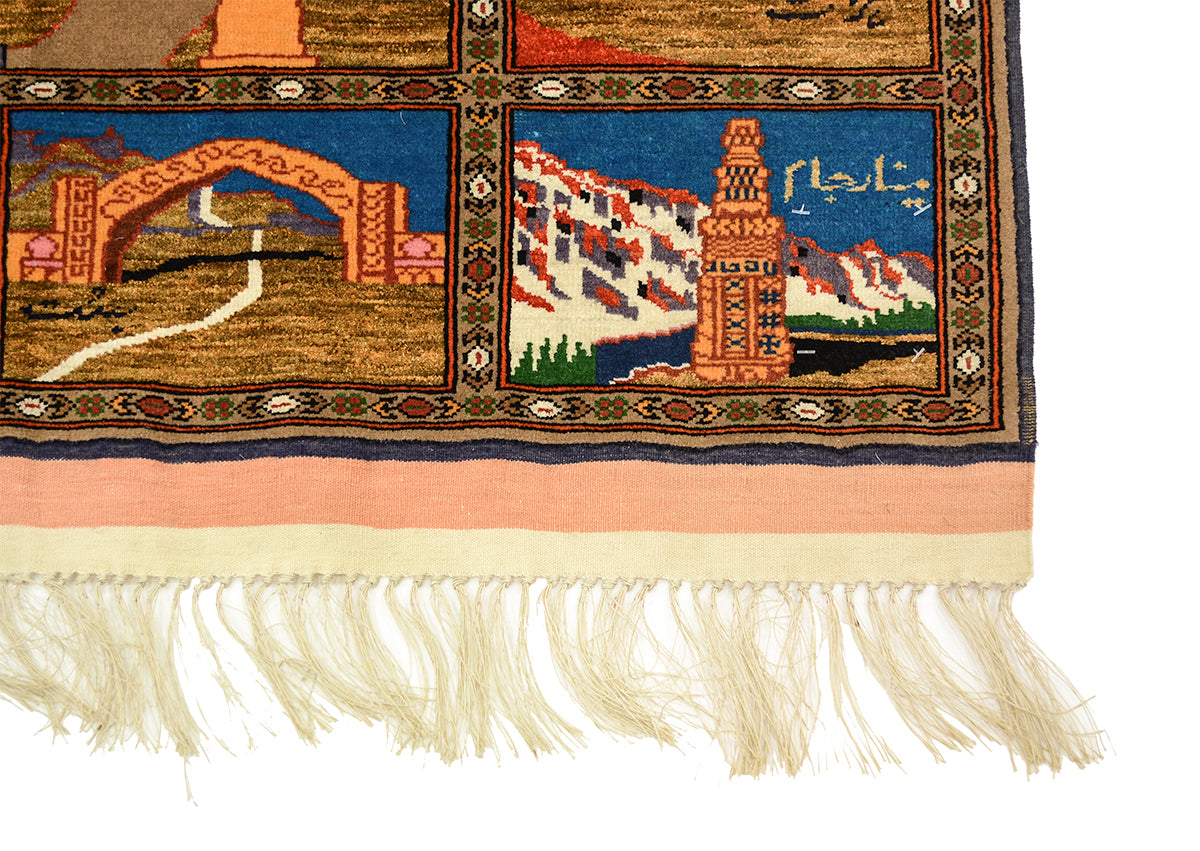
This intriguing fine pictorial Afghan rug with wool and silk pile was meticulously handwoven and is inscribed "made by Meyza Hosain" in English script. This finely woven pictorial rug features a central picture, which is bordered by 14 smaller pictures. Each image is framed by a border. The images shown in the pictures are significant to Afghanistan. In a way it is like a postcard, but in rug-form.
Learn some more about this fascinating fine Pictorial Afghan rug
In the central image of the rug, also in English script are the words "Taq Zafar". This is of great cultural significance to Afghan people. In Dari/Persian "Taq" means arch, and "Zafar" means victory. The central image of this small fine rug is therefore depicting "Taq-e Zafar" or the Arch of Victory in Paghman.
Taq-e Zafar is of great importance to Afghanistan because it commemorates Afghanistan's independence following the Third Anglo-Afghan War of 1919. We can see this date shown also in this part of the rug. It thus represents a significant time in Afghanistan's history.
The Arch of Victory was completed in 1928 during the reign of King Amanullah Khan. It is situated at the entrance to the gardens of Paghman, near to Kabul. In terms of design, the monument is rather European in style, sometimes drawing comparisons as a smaller version of the Arc de Triomphe in Paris.
As a symbol to this day, Taq-e Zafar is much more important that just an old building, it is symbolic of Afghanistan's independence and the sacrifices made by the Afghan people.
Find out about the other famous Afghan depictions in this Wool & Silk small Rug
This Afghan Pictorial rug depicts other famous places from across Afghanistan, starting from the top left corner and working down the column the images depict:
- Minaret of Jam, which is a 12th Century brick minaret. It stands dramatically in a remote mountain valley near the confluence of the Hari River and the Jam River in Ghor Province, central-west Afghanistan. The surrounding mountains shown in the rug are characteristic of its isolated setting.
- Bamiyan; this was the site of the famous giant cliff-faced Buddha statues which were destroyed by the Taliban in 2001.
- Band-e Amir; the famous chain of six intensely blue lakes in Bamiyan province. The image shows the broad blue water, rugged layered mountains, and small green shoreline are consistent with a stylised depiction of the lakes.
- Taq-e Zafar; refer to above information.
- Maimana; capital of Faryab province, Northern Afghanistan. The rug maybe depicts the shrine of Saif al-Muluk - this monument no longer exists, having been demolished in the Twentieth Century.
What this Taq Zafar rug is made from
This high quality small rug is made from wool and silk. The intricately hand-knotted pile is made from wool and silk. The tan-brown colour of the land is shown in silk and the white of the mountain sides are also silk. The rest of the design is fine hand-knotted wool in blue, green and orange.
For the warp threads, silk has been used. The warps are also the fringes of the rug, and each strand of silk fringe runs through the rug and exits at the other end. These long silk threads were the first yarns to be added onto the loom before the weaving began. For making a high knot count rug, silk is a perfect material for warp threads. Not only is it thin which allows for extra tiny detailed knotting, it also has excellent tensile strength.
In this small part silk rug, in between each row of knots are woollen weft threads which are closely sandwiched between the lines of knots. These wefts are woven in between the warps and are compacted closely against the knots.
Key details:
- Country of origin: Afghanistan
- Size: 86×93cm / 2’10x3’1 (this measurement includes the kilim end finishes).
- Thickness: 5mm
- Pile: Silk and Wool, hand-knotted
- Warp: Silk
- Age: Noughties. Unused
In stock! Ships within 1-2 business days.
Free shipping in the UK
Need advice? We can advise on the best purchase for your requirements.
14 day return policy
-
Shipping Information
Free Shipping to customers in the UK for all Rugs and Carpets. Your purchase will be packed with immense care and also well protected in order to arrive at your home in perfect condition!
Rest assured that all parcels we send will have a tracking number and will be shipped by our choice of well established courier/parcel companies that we trust with our products and your future purchases.
-
Customer Support
We would be delighted to help you with any enquiries you have. Please contact us:
Tel: 01892 533 080
WhatsApp Number: 07704 663443
Frequently asked questions about Afghan rugs
Oriental rugs are renowned for their longevity and can often last for generations.
I’d like to buy it, is the rug shown the rug I’ll get?
Yes, all of our rugs are handmade and the vast majority are one-of-a-kind. This is the exact rug you will receive. No substitutions.
I’m interested in this rug, but would like to see it before I decide – can I come and see it at your shop?
Of course! All of the rugs displayed and shown as in stock on our website are available to view and buy in-store.
How quickly will I receive my rug and how much does delivery cost?
We aim to dispatch our Rugs as quickly as possible. Deliveries in the UK are generally achieved in 2-3 working days. Within the UK there is no carriage charge for rugs.
I’m not located in the UK, will you send it to destinations outside of the UK?
Please contact us, referencing which rug you would like to buy and your delivery address to find out shipping costs.
How long will my rug last?
Hand-knotted Rugs and Handwoven Rugs are extremely long-lasting items. If properly looked after Oriental Rugs can outlive their owner and maybe even last for generations. In many cases rugs improve with age.
Will the colours of my rug fade?
Handmade Oriental rugs will soften in colour over time. Of course, like any textile, if the rug is used in an area of strong sunlight, such as in a Conservatory for instance, the fading process will be more rapid. During days of strong sunshine, it is good practice to draw the curtains or blinds to keep your Oriental rug looking at its best.
Will the colours transfer onto the flooring underneath?
This is a tricky one to answer! If only we had a crystal ball! There is a risk. Our rugs are all handmade and made with artisan dyes. All of our rugs are thoroughly washed prior to export and any excess dye should come out in the washing process. However, on the odd occasion, the dye can still sometimes transfer. This phenomenon is increased by humidity and temperature, and is regrettably irreversible. If you are concerned about this possibility, perhaps consider using an Underlay to put a barrier between the rug and the flooring/fitted carpet underneath.
How do I care for my Afghan Rug
They are easy to care for, but here’s a few helpful pointers to keep your new Afghan rug looking great:
Vacuum
Hoover it regularly – perhaps once a week. This is good practice as tiny dirt particles can cause premature wear. Vacuum it with just the nozzle suction, as rotating brushes can be abrasive. Try to keep the vacuum cleaner away from the fringes as this is probably the weakest point on an Oriental rug; fringes and vacuum cleaners don’t mix!
Rotate
It is a good idea to rotate your Afghan rug on occasion. This will help prevent areas of concentrated wear. Foot shuffling when watching the TV is a prime culprit! Rotating your rug will also help to even-out any incremental changes in colour from exposure to sunlight.
Blot
Any spills should be blotted immediately: blot with kitchen towel or clean un-dyed absorbent cloth; avoid rubbing or scrubbing which can spread the spill or push the spill deeper into the rug.
Use a Rug Underlay
A good rug underlay will keep the rug in place, thereby preventing uneven wear and will help the rug keep from going out of shape.
Professional Cleaning
This is something that is required infrequently, perhaps every 3-5 years depending on use. Please contact us if you would like to have your rug cleaned as we offer a Rug Cleaning Service.