
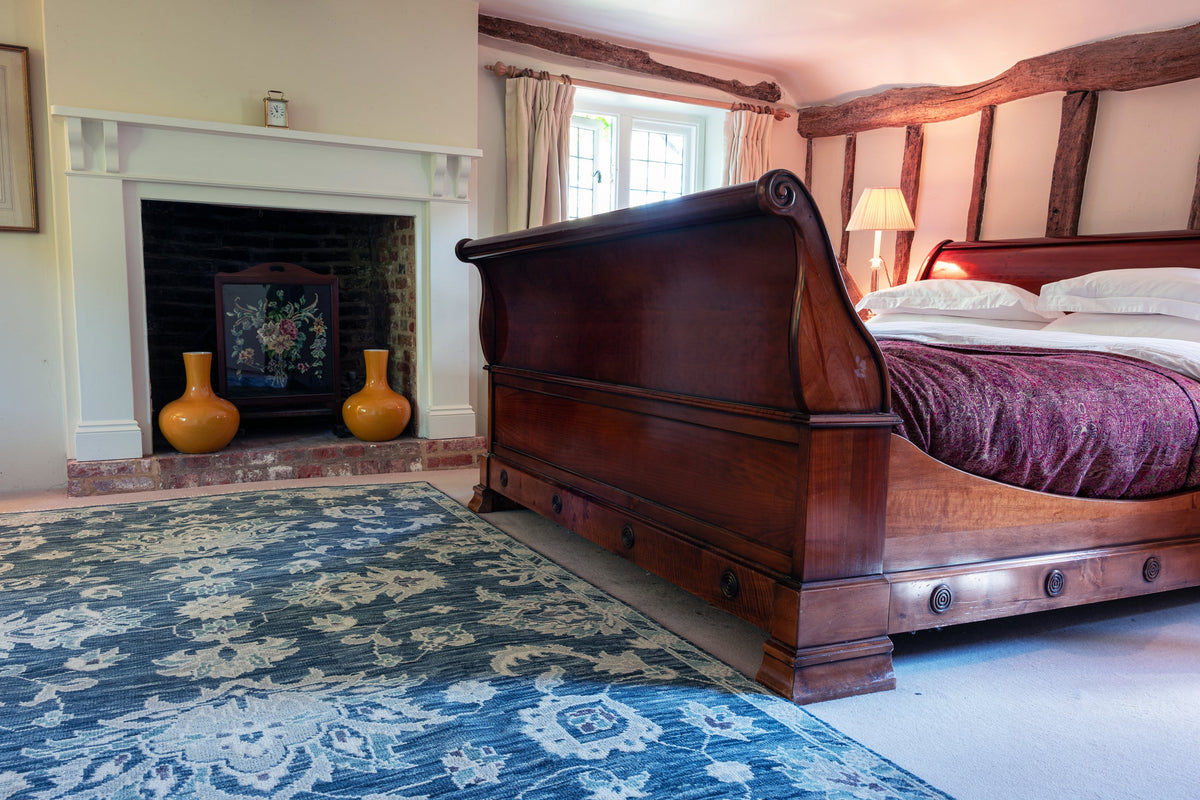
Often customers ask us what is the best way to choose a rug for their interior and to help make this journey easier for you here are some helpful tips to guide you choosing a rug, carpet or kilim. We would like to help you choose a piece that is right for your lifestyle and aesthetic.
How to Choose Unique Handwoven Rugs
Every handwoven piece is unique and has a story to tell already with it's creation, construction and design. This is because Oriental Rugs are created by skilled weavers with the human input of handweaving, cultural heritage, choice of materials, as well as different colour combinations for diverse interiors. In choosing a handmade piece you will add to that story about how and why you chose a particular piece for your home.
Whilst perusing our website, or visiting us in store, your ideas and preconceptions can evolve. The most important tip is to let yourself be immersed and inspired by the artistic vision of the creatives that produce these wonderful woven works of art. Rugs are not only decorative but also practical.
Choosing The Right Rug Size
First things first! Before leaping into your journey of soft-scaping and discovering the fascinating world of Oriental Rugs, it is best to check your ideal rug dimensions. Be confident and thorough in measuring your chosen space, room, or area. This will dictate your absolute minimum and maximum sizes and will help broaden your choices. You might want to convey a particular mood, style, weave, colour or functionality. There are practicalities to take into account, but once these have been achieved in working out your minimum and maximum dimensions on length and width then the fun can begin. Combined with the authenticity of a personal aesthetic whether vintage, antique or modern, pile of flatweave, and style choices of pictorial, geometric, floral, abstract, traditional, classic or tribal.
Choosing Rugs for Rooms; A Journey of Discovery
Being open minded and curious is a great tip and starting point to broaden your rug choosing experience. You may have some preconceived ideas about what you might be looking for (or indeed may have already explored some inspiring pieces on our website that resonate with your decor vision). Allowing an element of surprise can be very rewarding. Having a comprehensive selection of pieces is not overwhelming because your ideas and concepts will be stimulated. Combining this artistic inspiration from rugs and carpets with flexibility and openmindedness; the results can be very successful as your personality and needs can be reflected in your scheme.
The mood you wish to achieve can be created and enhanced by your rug choice. Remembering to consider areas of footfall in rooms will also help you in choosing the most suitable weave and pile. You may not want a fine light cream rug in your bootroom or high traffic hallway, but it may be ideal for a bedroom, dressing room or drawing room. Your lifestyle, the practicalities of your chosen room, your style, and budget will also dictate choices.
Find the Rug that Reflects your Style
Finding the rug for you is all about your style, home and your own personal aesthetic. Your gut reactions and decisions can be trustworthy natural responses. Sometimes it is easy to describe why you feel a particular affinity for a piece that resonates with you. It could be the pile height, the combination of colours or pleasing design. Like other art works you have in your home it may simply just appeal to you, and that is enough. It becomes a piece that you will enjoy for years to come.
Hypothetically, if you were to turn tables with a well-meaning friend or relative, be sure to know that there are probably art works and decor in their home that may not appeal to your tastes, so the likelihood of them agreeing with your own personal tastes is equally unlikely.
There is no right or wrong, except for not trusting your own judgement and aesthetic for your homestyle and needs.
Understanding Rug Materials and Benefits of Handmade Rugs
Oriental Rugs are handmade and woven with natural fibres. Handwoven rugs may contain combinations of wool, cotton, silk, jute or art silk (plant based) in varying proportion in pile, warp or wefts. By opting for a handmade Oriental Rug or Kilim flatweave you have already made a sustainable choice. In choosing a handwoven piece with natural fibres you have also made a good environmental decision. Rugs made with pure wool pile are one of the most sustainable decorating art forms. Wool is naturally flame resistant, robust yet springy, insulating, easy-to-clean and maintain, sustainable, renewable and biodegradable. Hence the numerous qualities and advantages of pure wool also helps in decision making.
Vintage rugs, re-invented or overdyed rugs, secondhand rugs, old, semi-antique and antique rugs also add to this important mindset of renewability. Not forgetting new handmade rugs with proper care and maintenance can also last for generations!
Different pile heights are also important to consider for suitability (not just patterns and colours). Antique wear, textured, cut pile, silk and wool or pure silk pile allows for varied textures and durabilities.
Traditional or Contemporary? Bold or subdued?
Being bold does not necessarily mean being bold in design or colour, but in your outlook and inquisitiveness. Many of our customers express an interest in the weaving and finishing processes of handmade rugs. If you are adventurous with the unexpected, you can enjoy bold or subdued, striking or restrained, quirky or classic, tribal, abstract modern or antique, geometric or curvilinear styles to choose from.
With handmade rugs and carpets in your scheme you can invite a statement focal point or desire something more nuanced to blend into your scheme. In many new Afghan and Indian pieces classic and historically famous carpet designs are artistically interpreted as traditional designs in colours and tonalities which are either bold or muted, or indeed an amalgamation. These traditional designs can be found in Afghan and Indian Zieglers, Oushaks, Sultanabads, Garous and Mamluk pieces.
Handmade Rugs and Craftmanship
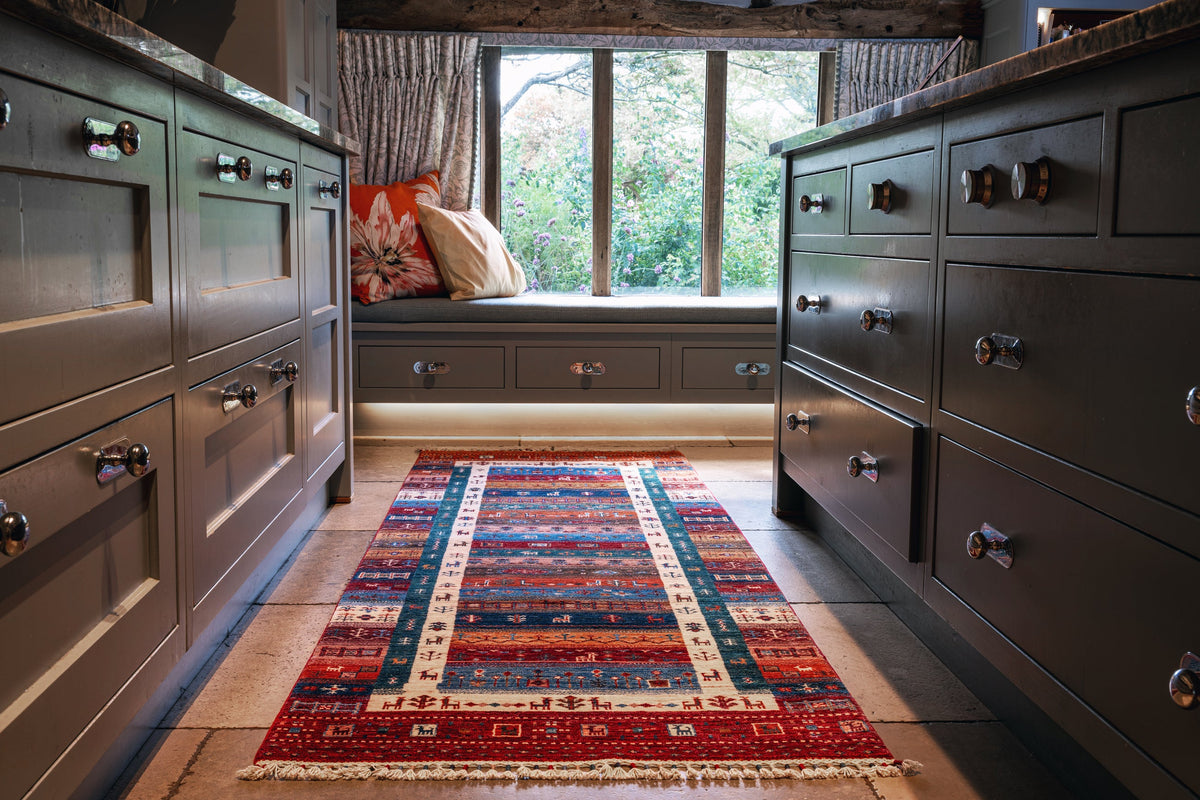
Handknotted and handmade rugs and carpets will help you set the decor mood you desire whether in a living room, snug, bedroom, under dining tables, kitchen areas and not forgetting home offices. Handwoven pieces not only bring disparate elements of a scheme together, anchoring a space and furniture, but also with their cohesion bring people together! Whatever style, weave or age of rug you choose, they will always be conversation pieces to be enjoyed by all ages within a household, including beloved pets!
Rug and carpets can be the basis to many scheme situations by defining an area, particularly in open-plan living set-ups, adding elegance, colour, texture and whatever atmosphere you wish to infuse your living space with. A rug will, by it's nature and skill of the weaver, allow a real sense of unique interest, insightfulness, fascinating construction and characteristic motifs, that you can continue to enjoy and impart to others.
Choosing the Right Colours and Colour Schemes with Rugs
Colour schemes don't have to be restrictive, but inclusive. The joy of handwoven pieces is that they already offer a myriad of different palettes from warm and cool neutrals, bright and bolds, pastel-tones to rich earthy or jewel-like hues. With rugs and carpets artistic combinations of superb balance of colour and texture can help a room become more coherent; suggesting and prompting to bring ideas forth in colour schemes. They can also simply harmonise with an already established scheme! Rugs and kilims are a great way to add colour to your home, but they are so much more than that. Human nature and artisanal handweaving make imaginative elements find their way into their creation and design.
Rugs boast a history of motifs, weaving techniques, dyeing, spinning and cultural design heritage all from different ethnic and geographic origins. Anything made by humans hands is infused with textile history and artistic value, adding not just a depth of colour, but also adding layers of interest. Modern interpretations of traditional carpet designs all add to the evolution of this arresting art form. With a rug you are not just adding colour or pattern but also authencity, enjoyment, uniqueness, comfort and practicality. Including rugs in areas of your home can add the unusual, the eclectic, harmony, restfulness, a sense of nuance, invigoration, timelessness or modernity.
A Note on Colour: some basic terms
Handmade Rugs, like any art work's patterning and colour can also be explained and described with distinctive colour combinations using complementary colour, contrasting colours and varying spectrum of differents hues to suit every taste.
Hues: Undiluted colours in their most intense luminosity; the twelve colours of the spectrum. Red, Red-Orange, Orange, Yellow-Orange, Yellow, Yellow-green, Green, Blue-Green, Blue, Blue-Violet, Violet, Red-Violet. On a colour wheel complimentaries are placed opposite each other.
Tints: One hue inflected with another; eg a greenish red
Tone: The light or dark value of a colour.
Complementaries: Are opposites of maximum contrast, eg blue/orange, red/green, yellow/violet. They are opposed by temperature ( ie warm against cool).
Simultaneous Contrast: Sometimes known as 'colour induction', ie a neutral area colour tends to induce it's complementary. If a grey area square onto a larger orange field, the blue complementary will be induced in the grey.
Saturation: Relates to the degree of intense purity of colour. Obviously spectrum hues are of maximum intensity. There are four ways of reducing saturation whilst retaining the basic colour; 1) by incorporating white 2) adding black 3) adding grey and 4) adding the complementary,
Extension: Contrast of extensions means contrast of proportion. It indicates the way in which harmony can be achieved by playing off a small proportion of one colour against a larger colour of another. The balance depends unpon the smaller proportion of colour having much great brilliance.
Colour Contrasts: 1) Hue 2) Light/Dark 3) Cold/Warm 4) Complementaries 5) Simultaneous 6) Saturation 7) Extension
Primary, Secondary and Tertiary Colours : Primary Colours in traditional colour theory are Red, Yellow and Blue. Secondary colours are created from a mix of two primary colours and Teritary colours come from mixing a primary with an adjacent secondary colours.

Share:
What is Abrash and how does it make rugs unique?
Decorating with Runner Rugs; A Guide to bringing Decorative Character into your Home.